Books by Simone Luigi Migliaro
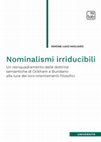
Tab edizioni, Roma, 2026
ENG: The question of the relationship between the semantic doctrines of William of Ockham and Joh... more ENG: The question of the relationship between the semantic doctrines of William of Ockham and John Buridan remains a subject of debate in the secondary literature. According to a traditional interpretation, the Parisian master is seen as a staunch defender of Ockhamist orthodoxy. An alternative interpretation, however, identifies a difference in the primacy that Ockham attributes to mental language, whereas Buridan attributes it to conventional language. This study challenges both interpretations. It shows how the differences between the two authors are profound and affect the very meaning of their nominalisms. However, the trajectory of this divergence suggests that Ockham is close to a form of conventionalism, while Buridan emerges as an uncompromising mentalist.
ITA: La questione dei rapporti tra le dottrine semantiche di Guglielmo d’Ockham e Giovanni Buridano è tutt’ora oggetto di dibattito nella letteratura secondaria. Secondo una lettura tradizionale, il maestro parigino sarebbe un convinto difensore del “credo” ockhamista. Un’interpretazione alternativa individua invece una differenza nella primarietà che Ockham attribuisce al linguaggio mentale, mentre Buridano a quello convenzionale. Questo studio contesta entrambe le letture, mostrando come le differenze tra i due autori siano profonde e investano il senso stesso dei loro nominalismi. Tuttavia, seguendo la traiettoria di questo divario, Ockham appare vicino a una forma di convenzionalismo, mentre Buridano si configura come un mentalista intransigente.
Periodicità annuale ISBN edizione cartacea 979-12-5669-311-5 ISBN edizione digitale 979-12-5669-3... more Periodicità annuale ISBN edizione cartacea 979-12-5669-311-5 ISBN edizione digitale 979-12-5669-312-2 Prima edizione: dicembre 2025 tab edizioni © 2025 Gruppo editoriale Tab s.r.l. viale Manzoni 24/c 00185 Roma www.tabedizioni.it È vietata la riproduzione, anche parziale, con qualsiasi mezzo effettuata, compresa la fotocopia, senza l'autorizzazione dell'editore. Tutti i diritti sono riservati. Studi sull'Aristotelismo medievale (secoli VI-XVI) anno 5, numero 5, dicembre 2025 a cura di SIMONE LUIGI MIGLIARO UNIVERSITÀ Indice p. 9 A Less Studied Averroistic Controversy. The Wide Rejection of Averroes' Agent Sense in the 13 th Century André Martin 55 Thomas Wylton on Common Sensibles Cecilia Trifogli 93 Necessitas condicionata, revelare condicionaliter, revelacio sub condicione.
Papers by Simone Luigi Migliaro
Studi sull'Aristotelismo medievale (Secoli VI-XVI), vol. 5, 2025
This paper explores some of Albert of Saxony’s original reflections on the internal status of men... more This paper explores some of Albert of Saxony’s original reflections on the internal status of mental language and on imposition, which have so far received little scholarly attention. Departing from more rigid lines of interpretation, the author maintains that concepts can ad placitum acquire additional semantic functions beyond their natural signification. At the same time, he sets clear limits to the act of impositio, which apply across all levels
of language: transcendental terms can never be re-instituted to signify something different. For all their novelty, Albert’s insights display significant ambiguities and risk internal contradictions when compared with other aspects of his logical doctrine. This study seeks to overcome these challenges by uncovering the foundational assumptions of his approach and proposing conjectural refinements to achieve a more coherent and comprehensive semantic theory.
Bulletin de Philosophie Médiévale, Volume 67, Issue 1,, 2025
Scholarly literature has identified two 14th-century masters of the arts named ‘John Aurifaber’: ... more Scholarly literature has identified two 14th-century masters of the arts named ‘John Aurifaber’: the earlier one was active around 1330 in the city of Erfurt; the later one was a pupil of Lawrence of Lindores and graduated from the University of Paris around 1397. The homonymy between these two Aurifaber has complicated the attribution of a commentary on Aristotle’s Physics, preserved in the manuscript Leipzig, Universitätsbibliothek, 1423. This paper reassesses the issue in light of L. Tomanek’s recent identification of the Quaestio de eventu necessario rerum quarumlibet, an Averroist-inspired text by the earlier Aurifaber, which defends a deterministic view of future contingents. Notably, similar themes appear in the Leipzig commentary, particularly in Book II, questions 8 (Utrum propositio de futuro contingenti sit determinate vera vel falsa) and 9 (Utrum omnia quae eveniunt eveniunt ex necessitate). Through a philosophical and textual analysis of these questions, this paper aims to: (1) demonstrate that the solutions in the Quaestio de eventu necessario differ from those in the Questions on the Physics, suggesting distinct authorship; and (2) highlight how the Questions on the Physics present innovative philosophical approaches to the issues of future contingents and divine foreknowledge, proposing a compatibilist solution in a form potentially uncommon in the late medieval period. The article concludes with a critical edition of these two questions.
Schola Salernitana - Annali, 30, 2025
The manuscript Tortosa, Archivo de la Catedral, 108 preserves, together with other texts, two com... more The manuscript Tortosa, Archivo de la Catedral, 108 preserves, together with other texts, two commentaries on the Ars vetus: the first structured per modum quaestionis, the second written in the form of an expositio. The attribution of both works has been debated in secondary literature. Building on Harald Berger's reflections, this contribution provides new evidence supporting John Buridan's authorship. In this perspective, the article first seeks to clarify the nature of the two commentaries, hypothesising an origin ex reportatione. Then it examines the quaestio secunda of the Commentary on Peri hermeneias, which offers doctrinal and terminological solutions similar to those of Buridan and divergent, on relevant points, from those of Albert of Saxony, the alternative author proposed in the literature. The article concludes with two appendices: the first provides an edition of the quaestio examined, while the second presents comparative tables between this text and Buridan's writings.

Truth and Concepts: the Role of the oratio mentalis in William of Ockham and John Buridan
Studies in the history of philosophy of mind, 2024
Abstract This article aims to elucidate the distinct roles that mental language occupies in the t... more Abstract This article aims to elucidate the distinct roles that mental language occupies in the theories of William of Ockham and John Buridan, focusing on their differing approaches to the problem of truth. The Venerabilis Inceptor believes that both mental propositions and spoken or written propositions can be properly true or false. Conversely, Buridan contends that only concepts can be true, whereas spoken and written languages possess truth merely in a metaphorical sense. This divergence underscores a fundamental difference in their nominalist frameworks. Ockham views semantic functions as sufficient to bridge language and reality. For this reason, he sees no need for a strict separation between concepts and other linguistic signs. Buridan, however, argues that semantics must be grounded in something intrinsic to the mind. Concepts, indeed, denote things only insofar as they enable us to know them in a specific way. In this epistemological-semantic duality, mental language assumes functions that spoken and written language cannot replicate.
In: Cunningham, J.P., Foxon, A., Gammie, R.M. (eds) Mind, Soul and the Cosmos in the High Middle Ages. Studies in the History of Philosophy of Mind, vol 31. Springer, Cham, pp. 197-2016.. , 2024
Abstract
This article aims to elucidate the distinct roles that mental language occupies in the t... more Abstract
This article aims to elucidate the distinct roles that mental language occupies in the theories of William of Ockham and John Buridan, focusing on their differing approaches to the problem of truth. The Venerabilis Inceptor believes that both mental propositions and spoken or written propositions can be properly true or false. Conversely, Buridan contends that only concepts can be true, whereas spoken and written languages possess truth merely in a metaphorical sense. This divergence underscores a fundamental difference in their nominalist frameworks. Ockham views semantic functions as sufficient to bridge language and reality. For this reason, he sees no need for a strict separation between concepts and other linguistic signs. Buridan, however, argues that semantics must be grounded in something intrinsic to the mind. Concepts, indeed, denote things only insofar as they enable us to know them in a specific way. In this epistemological-semantic duality, mental language assumes functions that spoken and written language cannot replicate.
In the 1980s, S. Ebbesen proposed, under the name of OXYNAT, a set of
postulates that could exp... more In the 1980s, S. Ebbesen proposed, under the name of OXYNAT, a set of
postulates that could explain the peculiar history of logica modernorum in the University of Paris in the period between the 13th and 14th centuries. According to that scholar, the generalized disappearance of terminist doctrine in continental context be tween 1270-1310 is directly related to the dominance achieved by Modist theories. Conversely, the revival of logic in Paris itself from 1310-20 onwards stems from an importation of content from Oxford, where the “summulistic” tradition never knew a
moment of stagnation. The present contribution seeks to supplement OXYNAT with some additional working hypotheses. The contents of Oxonian logic do not seem to have been passively received in Paris, but rather reworked in such a way as to adapt to what had long been dominant in the European context. This may have generated two new avenues: on the one hand, a realist terminism ready to draw from the doctrine of modi significandi an additional basis for giving legitimacy to the theories of logica modernorum; on the other hand, the attitude of those who, in order to defend them selves against the exaggerations of the grammarians, tended to give new form to the nominalist-inspired approach. From this point of view, the interesting similarities between the logical-semantic theories of Buridan and Aurifaber suggest the existence of a common background, still largely to be explored.
Documenti e studi sulla tradizione filosofica medievale, 2022
This paper aims to reconstruct the earliest origins of the debate on the signification
of voices... more This paper aims to reconstruct the earliest origins of the debate on the signification
of voices, which arose in the second half of the 13th century. this topic is approached with a comprehensive and multi-faceted strategy, through which I try to show that the problem of signification is intertwined with issues from other philosophical fields. the birth of the celebrated magna altercatio can be fully understood in the light of the discussions on the function performed by the species in the cognitive processes. At the same time, in the background of epistemological and psychological issues concerning the species, metaphysical considerations also play a decisive role in guiding the semantic choices of medieval authors. this paper consists of two parts. Part I opens with an overview of Aristotle’s semantics, or more specifically, the psychologizing reading that Boethius gives of Peri hermeneias. then, I discuss the arrival of the De anima in the Latin West and focus on how the notion of species is introduced into Aristotelian logic. Subsequently, I take Albert the Great as an emblematic example and attempt to show the connections between his semantics and his psychological doctrine. At the end of Part I, my attention focuses on Thomas Aquinas and his innovations. In part II, I consider some of the very first examples of an ‘extensional notion’ of signification, that is Roger Bacon, Siger of Brabant, Peter of Auvergne, Peter of Cornwall, and Richard Clive.
Dal 'significare' al 'concipere': alcune riflessioni sugli esiti della semantica di Buridano
Studi sull'Aristotelismo medievale (secoli VI-XVI), 2021
This essay aims to deepen the semantic doctrine of John Buridan, in the light of the first three ... more This essay aims to deepen the semantic doctrine of John Buridan, in the light of the first three conclusions that he formulates in the first chapter of his 'Sophismata'. In particular, it is shown how in the thought of the Parisian master the notion of signification is conceived as a transitive attitude, which spreads between the different levels of language and determines their relations of subordination. Particular attention is paid to the 'evidentiae' proposed by the author in support of his theses. These arguments, in fact, turn out to be relevant not only for their theoretical pertinence, but also for their feature of fixing unequivocally the characteristics, as well as the speculative scope of some fundamental notions of scholastic logical doctrine. Eventually, one tries to show how at the basis of Buridan's theories lies the attention he devotes to the cognitive function performed by language, which justifies the passage from signifying ('significare') to conceiving ('concipere'), as soon as the discursive dynamic reaches the mental level.
Challenging Common Sense: Singular Terms Referring to Many in Late Medieval Thought
Schola Salernitana - Annali, XXVI (2021), pp. 23-65, 2021
Il contributo si propone di produrre un’introduzione sistematica e meditata ad alcune premesse fo... more Il contributo si propone di produrre un’introduzione sistematica e meditata ad alcune premesse fondamentali della semantica di Giovanni Buridano, il famoso maestro che insegnò all’università di Parigi nel XIV secolo. Inizialmente, l’attenzione è posta sulla cosiddetta dottrina dei “livelli linguistici”, la quale prevede il riconoscimento di tre tipologie divergenti di oratio (scritta, vocale e mentale), e ai parallelismi di tipo semantico, e non sintattico, sussistenti tra di essi. Proseguendo su questa scia, viene trattata la differenza tra termini significativi ad placitum e naturaliter e si riflette – non senza allusioni alla cultura contemporanea – sui divergenti meccanismi impositivo-istitutivi descritti dal maestro piccardo, che condurrebbero all’istituzione e all’elaborazione di nuove tipologie di linguaggio. Successivamente, il focus è posto sulla rielaborazione originale – proposta nei primi paragrafi del De suppositionibus – della nozione di significatio, che viene non soltanto ad assumere una predisposizione cognitivo-intensionale, ma si configura come un processo che, insediandosi nelle normali dinamiche comunicative, può dirsi compiuto soltanto quando c’è un reale intendimento tra le parti. Nelle pagine conclusive, inoltre, viene evidenziata la profonda coerenza di buona parte dei contenuti della semantica buridanea con questa impostazione di base.
Reviews by Simone Luigi Migliaro
Review: Hugo Eterianus, Epistolae. De sancto et immortali Deo. Compendiosa expositio. Fragmenta graeca quae extant
Schola Salernitana - Annali, 2021
PhD Thesis by Simone Luigi Migliaro
PhD Thesis, 2024
According to a well-known and traditional historiographical reading, Ockham’s and Buridan’s logic... more According to a well-known and traditional historiographical reading, Ockham’s and Buridan’s logical-semantic doctrines would stand on a visible and indissoluble continuity. In the Introduction of his English translation of Sophismata, for example, T. K. Scott presented Buridan as the «stolid practitioner» of the Ockhamist «creed»; this is because the Parisian master – in incorporating the methods, contents, intentions and even the nominalist spirit of his predecessor – had succeeded in following up and completing what the Venerabilis Inceptor had begun. Although this reading has also gathered consensus and approval in more recent times, J. Biard and other scholars have preferred to downgrade, at least partially, this line of continuity, making Ockham a “mentalist” and Buridan a “conventionalist”. According to this interpretation, the Venerabilis Inceptor would assume the oratio mentalis as fundamental, giving external discourses a clearly secondary and derivative role; conversely, Buridan would attribute primacy to conventional languages, putting in clear subordination the conceptual one – which, according to J. Zupko, should not even be considered a language in the proper sense.
Adopting a holistic-systematic approach, which aims to evaluate the subject in the more general context of the gnoseological and metaphysical doctrines advocated by the two authors, the present work has the following aim: to show how the difference between Ockham and Buridan, in the field of semantics of terms, is actually even more radical than the secondary literature has so far come to suggest. Such a distance emerges not only with reference to the contents and doctrinal positions they specifically upheld, but also in relation to the aims and objectives of their linguistic constructions; indeed, it even goes so far as to involve the deepest sense of their nominalisms, which precisely for this reason are to be seen as “irreducible”. In this sense, any attempt to retrieve Buridan within Ockhamism might be inadequate. Moreover, observed from the right perspective, the gap between the two authors seems to proceed in a direction that paradoxically reverses the interpretative paradigm established by Biard and followed by others.
The Venerabilis Inceptor, in fact, builds his system on an obvious extensionalist inclination, which has as its ultimate goal the legitimisation of his nominalism. This leads him to emphasise to the utmost the direct relationship between signs and reality and to eradicate from the field of enquiry any question of knowledge. The consequence is that it seems totally unnecessary to him to place a “rigid” hierarchy of priorities between the different levels of language; indeed, he even considers it possible that the mental discourse largely integrates – ad placitum – modalities and contents of the conventional ones. Conversely, in the terminism of Buridan’s matrix there is a more general disinterest in ontology. The Parisian master sees semantics as an extension of gnoseology, or rather as an instrument to account not for the ultimate constitution of reality, but for man’s cognitive capacities. All this translates into a clear and constant attribution of centrality to mental discourse, which not only constitutes a language, but is the only one that can actually be a language.
The thesis is structured in three different sections, with a total of seven chapters. The first section delves into the debate on the signification of spoken words, which began in the second half of the 13th century, and proposes to re-read its origins in the light of the evolutions of the gnoseological-ontological paradigms of the period. The second section, accordingly, analyses some of the fundamental premises of Ockham’s and Buridan’s philosophical systems, paying particular attention to the different ways in which they approach the following themes: 1) the problem of the structure framing of reality; 2) the role of representations in cognitive processes; 3) knowledge of the singular; 4) the nature of the concept and its functions. The last section undertakes an analytical comparison between the semantic doctrines of the two authors, conducted on the basis of their theories of signification, supposition, connotation and appellation. The section concludes with an analysis of the different ways in which Ockham and Buridan discuss the more proper origin of the different types of particles in oratio mentalis, and the logical-semantic properties that truly belong to it.
The thesis includes in the appendix some of Buridan’s texts that have played a relevant role in the overall interpretation of this author. Appendix I contains a provisional edition, based on five manuscripts, of questions 9 and 11 of Book III of the commentary on De anima, taken in its secunda lectura or non de ultima lectura redaction. Appendix II presents a provisional edition of some extracts, transcribed on the basis of the two known codices, of the Defensiones determinationis de diversitate generis ad speciem.
Conferences by Simone Luigi Migliaro
Abstract of the paper presented at the session "Cognition and Semantics" (Society for Medieval an... more Abstract of the paper presented at the session "Cognition and Semantics" (Society for Medieval and Renaissance Philosophy Conference), 13th Annual Symposium on Medieval and Renaissance Studies, Saint Louis University, 9 June 2026
Presented to the Conference 'Sostanza e categorie tra Medioevo ed Età Moderna. Il rapporto tra co... more Presented to the Conference 'Sostanza e categorie tra Medioevo ed Età Moderna. Il rapporto tra conoscenza e ontologica nella tradizione aristotelica', L'Aquila, 9-11/12/2025
Titolo: Semantica e ontologia in Guglielmo d’Ockham e Giovanni Aurifaber: due teorie della connotazione a confronto
Abstract: Notoriamente, Guglielmo d’Ockham ammette nella propria ontologia, riconoscendole come res a tutti gli effetti, soltanto le sostanze e determinate qualità. Partendo da questa intuizione fondamentale, egli offre una peculiare rilettura della dottrina delle Categorie di Aristotele, che tiene conto delle diverse funzioni che i termini possono acquisire. Soltanto i nomi che ricadono nel genere della sostanza e alcuni di quelli della qualità possono essere considerati absoluti, poiché essi esauriscono la propria capacità semantica nella significazione di un’unica tipologia di res. Tutti gli altri categoremi, invece, sono connotativi. Concretamente, ciò vuol dire che possiedono una duplice capacità semantica: essi significano primariamente e secondo un certo modo grammaticale una certa res, ma rimandano secondariamente, e secondo un differente modo grammaticale, a qualcos’altro. Tuttavia, queste res a cui i diversi termini si riferiscono primariamente o secondariamente sono sempre delle sostanze o delle qualità, essendo soltanto queste a costituire il mondo esterno.
Pur condividendo l’ontologia riduzionista di Ockham, Giovanni Aurifaber considera problematica la dottrina della connotazione caldeggiata dal Venerabilis Inceptor – o comunque da chi ne segue più fedelmente le orme. Egli ne discute approfonditamente nella Quaestio 8 del libro I del suo Commento alla Fisica, su cui si concentrerà prevalentemente questa presentazione. Se si ammette che anche i termini della quantità, della relazione e simili significhino res che sono o sostanze o qualità, allora tali termini dovrebbero ricadere in queste ultime due categorie. Per questo motivo, Aurifaber sostiene che soltanto i termini absoluti abbiano un referente reale e ontologicamente determinato; al contrario, quelli connotativi non designano alcuna res, ma soltanto un modo d’essere. Sulla base di questa intuizione, l’autore propone una dottrina semantica originale che, di fatto, comporta una rilettura generale di alcuni contenuti fondamentali della logica scolastica, quali l’individuazione dei termini nelle differenti categorie, la distinzione tra termini astratti e concreti o tra termini vuoti e connotativi, e la definizione della funzione semantica dei trascendentali.
Title of my talk: Indirect Knowledge and Singular Terms: A Theoretical Challenge for Aquinas and ... more Title of my talk: Indirect Knowledge and Singular Terms: A Theoretical Challenge for Aquinas and Hervaeus Natalis
Abstract:
Medieval semantic theories were long developed on the basis of a strong parallelism between the processes of signification and those of cognition. However, since intellectual knowledge was primarily tied—according to Aristotelian standards—to universals, this premise made it difficult for a long time to explain the logical function of singular terms. This paper examines the issue in the systems of Thomas Aquinas and Hervaeus Natalis. The former identifies the primary meaning of spoken words in the conceptio intellectus, which coincides with the quiddity of the thing as it becomes universal by being abstracted from material conditions. For this reason, his system does not seem to allow for the existence of terms capable of signifying a single individual since such an entity is not apprehended in the conceptio itself, but only through an indirect act of reflection on the intellectual act. Conversely, Hervaeus Natalis succeeds in developing a more coherent system by distancing himself from Thomas on two key points: (1) a stronger realist attitude, which leads him to see the res—whether directly or indirectly understood—as the terminus of intellectual activity; and (2) an extensional notion of signification, which locates the primary meaning of words in things rather than in concepts.
Title of the paper: Mental Language Across and Within Boundaries: William of Ockham’s Dynamic The... more Title of the paper: Mental Language Across and Within Boundaries: William of Ockham’s Dynamic Theory
Abstract: Although Fodor’s Language of Thought Hypothesis has met with wide consensus among contemporary scholars, the same does not apply to the idea that primitive concepts are “innate” – and thus also shared by all human beings. Unlike Fodor, Ockham believes that the mind acquires its basic contents from reality. In this sense, concepts constitute natural signs of the things from which they derive. But the mechanisms of content acquisition from reality are not per se able to explain all the functions that can be assumed by mental signs. It is for this reason that Ockham proposes a radical thesis: there are conceptual functions that derive from an act of imposition. The application of this principle allows the author to account for why it is possible for us to think “in words”. This creates a dynamic situation that enables the language of thought to be composed of both elements and characteristics common to all people and others that reflect cultural differences.
Title of my paper: The Problem of Future Contingents and Divine Foreknowledge in John Aurifaber



Uploads
Books by Simone Luigi Migliaro
ITA: La questione dei rapporti tra le dottrine semantiche di Guglielmo d’Ockham e Giovanni Buridano è tutt’ora oggetto di dibattito nella letteratura secondaria. Secondo una lettura tradizionale, il maestro parigino sarebbe un convinto difensore del “credo” ockhamista. Un’interpretazione alternativa individua invece una differenza nella primarietà che Ockham attribuisce al linguaggio mentale, mentre Buridano a quello convenzionale. Questo studio contesta entrambe le letture, mostrando come le differenze tra i due autori siano profonde e investano il senso stesso dei loro nominalismi. Tuttavia, seguendo la traiettoria di questo divario, Ockham appare vicino a una forma di convenzionalismo, mentre Buridano si configura come un mentalista intransigente.
Papers by Simone Luigi Migliaro
of language: transcendental terms can never be re-instituted to signify something different. For all their novelty, Albert’s insights display significant ambiguities and risk internal contradictions when compared with other aspects of his logical doctrine. This study seeks to overcome these challenges by uncovering the foundational assumptions of his approach and proposing conjectural refinements to achieve a more coherent and comprehensive semantic theory.
This article aims to elucidate the distinct roles that mental language occupies in the theories of William of Ockham and John Buridan, focusing on their differing approaches to the problem of truth. The Venerabilis Inceptor believes that both mental propositions and spoken or written propositions can be properly true or false. Conversely, Buridan contends that only concepts can be true, whereas spoken and written languages possess truth merely in a metaphorical sense. This divergence underscores a fundamental difference in their nominalist frameworks. Ockham views semantic functions as sufficient to bridge language and reality. For this reason, he sees no need for a strict separation between concepts and other linguistic signs. Buridan, however, argues that semantics must be grounded in something intrinsic to the mind. Concepts, indeed, denote things only insofar as they enable us to know them in a specific way. In this epistemological-semantic duality, mental language assumes functions that spoken and written language cannot replicate.
postulates that could explain the peculiar history of logica modernorum in the University of Paris in the period between the 13th and 14th centuries. According to that scholar, the generalized disappearance of terminist doctrine in continental context be tween 1270-1310 is directly related to the dominance achieved by Modist theories. Conversely, the revival of logic in Paris itself from 1310-20 onwards stems from an importation of content from Oxford, where the “summulistic” tradition never knew a
moment of stagnation. The present contribution seeks to supplement OXYNAT with some additional working hypotheses. The contents of Oxonian logic do not seem to have been passively received in Paris, but rather reworked in such a way as to adapt to what had long been dominant in the European context. This may have generated two new avenues: on the one hand, a realist terminism ready to draw from the doctrine of modi significandi an additional basis for giving legitimacy to the theories of logica modernorum; on the other hand, the attitude of those who, in order to defend them selves against the exaggerations of the grammarians, tended to give new form to the nominalist-inspired approach. From this point of view, the interesting similarities between the logical-semantic theories of Buridan and Aurifaber suggest the existence of a common background, still largely to be explored.
of voices, which arose in the second half of the 13th century. this topic is approached with a comprehensive and multi-faceted strategy, through which I try to show that the problem of signification is intertwined with issues from other philosophical fields. the birth of the celebrated magna altercatio can be fully understood in the light of the discussions on the function performed by the species in the cognitive processes. At the same time, in the background of epistemological and psychological issues concerning the species, metaphysical considerations also play a decisive role in guiding the semantic choices of medieval authors. this paper consists of two parts. Part I opens with an overview of Aristotle’s semantics, or more specifically, the psychologizing reading that Boethius gives of Peri hermeneias. then, I discuss the arrival of the De anima in the Latin West and focus on how the notion of species is introduced into Aristotelian logic. Subsequently, I take Albert the Great as an emblematic example and attempt to show the connections between his semantics and his psychological doctrine. At the end of Part I, my attention focuses on Thomas Aquinas and his innovations. In part II, I consider some of the very first examples of an ‘extensional notion’ of signification, that is Roger Bacon, Siger of Brabant, Peter of Auvergne, Peter of Cornwall, and Richard Clive.
Reviews by Simone Luigi Migliaro
PhD Thesis by Simone Luigi Migliaro
Adopting a holistic-systematic approach, which aims to evaluate the subject in the more general context of the gnoseological and metaphysical doctrines advocated by the two authors, the present work has the following aim: to show how the difference between Ockham and Buridan, in the field of semantics of terms, is actually even more radical than the secondary literature has so far come to suggest. Such a distance emerges not only with reference to the contents and doctrinal positions they specifically upheld, but also in relation to the aims and objectives of their linguistic constructions; indeed, it even goes so far as to involve the deepest sense of their nominalisms, which precisely for this reason are to be seen as “irreducible”. In this sense, any attempt to retrieve Buridan within Ockhamism might be inadequate. Moreover, observed from the right perspective, the gap between the two authors seems to proceed in a direction that paradoxically reverses the interpretative paradigm established by Biard and followed by others.
The Venerabilis Inceptor, in fact, builds his system on an obvious extensionalist inclination, which has as its ultimate goal the legitimisation of his nominalism. This leads him to emphasise to the utmost the direct relationship between signs and reality and to eradicate from the field of enquiry any question of knowledge. The consequence is that it seems totally unnecessary to him to place a “rigid” hierarchy of priorities between the different levels of language; indeed, he even considers it possible that the mental discourse largely integrates – ad placitum – modalities and contents of the conventional ones. Conversely, in the terminism of Buridan’s matrix there is a more general disinterest in ontology. The Parisian master sees semantics as an extension of gnoseology, or rather as an instrument to account not for the ultimate constitution of reality, but for man’s cognitive capacities. All this translates into a clear and constant attribution of centrality to mental discourse, which not only constitutes a language, but is the only one that can actually be a language.
The thesis is structured in three different sections, with a total of seven chapters. The first section delves into the debate on the signification of spoken words, which began in the second half of the 13th century, and proposes to re-read its origins in the light of the evolutions of the gnoseological-ontological paradigms of the period. The second section, accordingly, analyses some of the fundamental premises of Ockham’s and Buridan’s philosophical systems, paying particular attention to the different ways in which they approach the following themes: 1) the problem of the structure framing of reality; 2) the role of representations in cognitive processes; 3) knowledge of the singular; 4) the nature of the concept and its functions. The last section undertakes an analytical comparison between the semantic doctrines of the two authors, conducted on the basis of their theories of signification, supposition, connotation and appellation. The section concludes with an analysis of the different ways in which Ockham and Buridan discuss the more proper origin of the different types of particles in oratio mentalis, and the logical-semantic properties that truly belong to it.
The thesis includes in the appendix some of Buridan’s texts that have played a relevant role in the overall interpretation of this author. Appendix I contains a provisional edition, based on five manuscripts, of questions 9 and 11 of Book III of the commentary on De anima, taken in its secunda lectura or non de ultima lectura redaction. Appendix II presents a provisional edition of some extracts, transcribed on the basis of the two known codices, of the Defensiones determinationis de diversitate generis ad speciem.
Conferences by Simone Luigi Migliaro
Titolo: Semantica e ontologia in Guglielmo d’Ockham e Giovanni Aurifaber: due teorie della connotazione a confronto
Abstract: Notoriamente, Guglielmo d’Ockham ammette nella propria ontologia, riconoscendole come res a tutti gli effetti, soltanto le sostanze e determinate qualità. Partendo da questa intuizione fondamentale, egli offre una peculiare rilettura della dottrina delle Categorie di Aristotele, che tiene conto delle diverse funzioni che i termini possono acquisire. Soltanto i nomi che ricadono nel genere della sostanza e alcuni di quelli della qualità possono essere considerati absoluti, poiché essi esauriscono la propria capacità semantica nella significazione di un’unica tipologia di res. Tutti gli altri categoremi, invece, sono connotativi. Concretamente, ciò vuol dire che possiedono una duplice capacità semantica: essi significano primariamente e secondo un certo modo grammaticale una certa res, ma rimandano secondariamente, e secondo un differente modo grammaticale, a qualcos’altro. Tuttavia, queste res a cui i diversi termini si riferiscono primariamente o secondariamente sono sempre delle sostanze o delle qualità, essendo soltanto queste a costituire il mondo esterno.
Pur condividendo l’ontologia riduzionista di Ockham, Giovanni Aurifaber considera problematica la dottrina della connotazione caldeggiata dal Venerabilis Inceptor – o comunque da chi ne segue più fedelmente le orme. Egli ne discute approfonditamente nella Quaestio 8 del libro I del suo Commento alla Fisica, su cui si concentrerà prevalentemente questa presentazione. Se si ammette che anche i termini della quantità, della relazione e simili significhino res che sono o sostanze o qualità, allora tali termini dovrebbero ricadere in queste ultime due categorie. Per questo motivo, Aurifaber sostiene che soltanto i termini absoluti abbiano un referente reale e ontologicamente determinato; al contrario, quelli connotativi non designano alcuna res, ma soltanto un modo d’essere. Sulla base di questa intuizione, l’autore propone una dottrina semantica originale che, di fatto, comporta una rilettura generale di alcuni contenuti fondamentali della logica scolastica, quali l’individuazione dei termini nelle differenti categorie, la distinzione tra termini astratti e concreti o tra termini vuoti e connotativi, e la definizione della funzione semantica dei trascendentali.
Abstract:
Medieval semantic theories were long developed on the basis of a strong parallelism between the processes of signification and those of cognition. However, since intellectual knowledge was primarily tied—according to Aristotelian standards—to universals, this premise made it difficult for a long time to explain the logical function of singular terms. This paper examines the issue in the systems of Thomas Aquinas and Hervaeus Natalis. The former identifies the primary meaning of spoken words in the conceptio intellectus, which coincides with the quiddity of the thing as it becomes universal by being abstracted from material conditions. For this reason, his system does not seem to allow for the existence of terms capable of signifying a single individual since such an entity is not apprehended in the conceptio itself, but only through an indirect act of reflection on the intellectual act. Conversely, Hervaeus Natalis succeeds in developing a more coherent system by distancing himself from Thomas on two key points: (1) a stronger realist attitude, which leads him to see the res—whether directly or indirectly understood—as the terminus of intellectual activity; and (2) an extensional notion of signification, which locates the primary meaning of words in things rather than in concepts.
Abstract: Although Fodor’s Language of Thought Hypothesis has met with wide consensus among contemporary scholars, the same does not apply to the idea that primitive concepts are “innate” – and thus also shared by all human beings. Unlike Fodor, Ockham believes that the mind acquires its basic contents from reality. In this sense, concepts constitute natural signs of the things from which they derive. But the mechanisms of content acquisition from reality are not per se able to explain all the functions that can be assumed by mental signs. It is for this reason that Ockham proposes a radical thesis: there are conceptual functions that derive from an act of imposition. The application of this principle allows the author to account for why it is possible for us to think “in words”. This creates a dynamic situation that enables the language of thought to be composed of both elements and characteristics common to all people and others that reflect cultural differences.