Papers by Rolf-Peter Horstmann
In a well-known Berlin aphorism, Hegel notes that a great man condemns people to explicate him (s... more In a well-known Berlin aphorism, Hegel notes that a great man condemns people to explicate him (see GW 22, 476). However, before we can explicate we must understand.
This text is a sequel to a paper published a while ago (The Limited Significance of Self-Consciou... more This text is a sequel to a paper published a while ago (The Limited Significance of Self-Consciousness.-In: Revue de Metaphysique et de Morale. 2010, 4. 435-454). That paper introduces and tries to justify the distinctions whose meaning and implications are elaborated here. Before dismissing the following remarks as based on unsubstantiated assumptions the reader might like to check the earlier text first. 2) These terms have a tradition, see the article 'Proposition' in P. Edwards (Ed.
Rolf-Peter Horstmann (Berlin) Den Verstand zur Vernunft bringen? Hegels Auseinandersetzung mit Ka... more Rolf-Peter Horstmann (Berlin) Den Verstand zur Vernunft bringen? Hegels Auseinandersetzung mit Kant in der Differenz-Schrift. * ‚Das Interesse des Denkens-Hegel aus heutiger Sicht', dies ist bekanntlich der Titel der Vortragsreihe, zu der auch der heutige Vortrag gehört. Was auch immer mit diesem schoenen Titel genau gemeint gewesen sein mag, man wird sich angesichts des gegenwärtigen Zustands wenigstens der akademischen Philosophie kaum des Eindrucks erwehren können, dass er nicht nur zu einer Bestandaufnahme, was mit Hegel heute so alles passiert, einladen soll. Vielmehr scheint er zugleich einer Hoffnung oder einem Wunsch des Inhalts Ausdruck geben zu sollen, dass man im Interesse des Denkens Hegel heute anders sehen möge als es in der neueren Vergangenheit der Fall gewesen ist. So berechtigt und so verständlich ein solcher Wunsch oder eine solche Hoffnung auch sein mag, es wird dabei implizit vorausgesetzt, dass man einen einigermaßen unkontroversen Sinn mit der suggestiven Formel vom Interesse des Denkens verbinden kann und dass ausgerechnet Hegel für diesen Sinn einstehen kann. Beides sind weitreichende Voraussetzungen, die zudem einen beträchtlichen Auslegungsspielraum bieten. Ich werde mich erst gar nicht daran versuchen, diesen Spielraum zu erkunden, sondern einfach davon ausgehen, dass-was auch immer das Interesse des Denkens genauer sein mag *) Die hier vorgelegten Ausführungen fassen in ihrem ersten Teil Überlegungen zusammen, die ich ausfuehrlicher mehrfach andernorts vorgestellt habe. Das Hegel-Bild, in das sie eingebettet sind, ist zuletzt dargestellt worden in D.
Rolf-Peter Horstmann (Berlin) Hermann Cohen on Kant's Transcendental Aesthetic. 1 Neo-Kantianism ... more Rolf-Peter Horstmann (Berlin) Hermann Cohen on Kant's Transcendental Aesthetic. 1 Neo-Kantianism is commonly understood by us as a German philosophical movement in the late 19 th and early 20 th century whose main representatives want to go back to Kant's central teachings in order to find a solid basis for their own systematic efforts in all fields of philosophy from epistemology and metaphysics to practical philosophy and philosophical aesthetics. The leading motive behind their program of going back to Kant seems to have been the conviction that Kant's philosophy is superior to other philosophical endeavors which misleadingly claim to have prevailed over Kant's approach though they end up with either totally unacceptable psychological (e.g. Herbart) or equally dubious pan-logistic (e.g. German idealists, esp. Hegel) constructions. This belief in the superiority of Kant's philosophy, however, seems to be rather startling given that this assessment is by no means evident. This is so not only because one could (and actually, in this age, did) think of the psychologistic and pan-logistic rivals of Kant's theory as themselves deeply rooted in Kant's philosophy and thus giving them the status of descendants of Kant's teachings. What makes this assessment even more surprising is that the starting point of the turn back to Kant in the 60 th of the 19 th century was connected with an acute criticism of the metaphysical implications of a fundamental element of Kant's epistemology-i.e. his distinction between appearance and thing in itself-thus forcing everyone who wants to built his philosophical
Wolfgang Carl zum 65. Geburtstag Kant und Carl über Apperzeption. In seinem zurecht viel bewunder... more Wolfgang Carl zum 65. Geburtstag Kant und Carl über Apperzeption. In seinem zurecht viel bewunderten Buch über den schweigenden Kant 1 , den Kant also, der sich über faktisch mehr als ein Jahrzehnt von 1770 bis 1781 dem Publikum schriftstellerisch verweigert hat, weil sich sein Projekt der Bestimmung der Grenzen der Vernunft und der Sinnlichkeit, uns unter dem Titel Kritik der reinen Vernunft bekannt, doch als sehr viel schwieriger erwies als ursprünglich von ihm angenommen,-in diesem ebenso informativen wie informierten Buch hat Wolfgang Carl auf das Genaueste den Weg bzw. die Wege untersucht, die Kant bei dem Versuch der Beantwortung der Frage eingeschlagen hat, wie sich reine Begriffe auf Gegenstände beziehen können, so die berühmt-berüchtigte Formulierung der Frage in dem Brief an Markus Herz aus dem Jahre 1772 2. Wie wirallerdings nicht erst seit Wolfgang Carl-wissen, ist es diese Frage, die Kant zu dem von ihm für mühevoll erklärten Unternehmen 3 einer Deduktion der reinen Verstandesbegriffe veranlasst hat. Welche Mühen im Detail tatsächlich mit diesem Unternehmen verbunden gewesen sind, dies jedoch wird erst richtig durch das Buch von Wolfgang Carl deutlich, indem es das ganze Spektrum von Problemen und das Arsenal der begrifflichen Mittel exponiert, die für Kant bei der Konzipierung einer Deduktion eine Rolle gespielt haben. Nun haben alle entwicklungsgeschichtlichen Rekonstruktionen der Überlegungen, die zu den dann letztlich von Kant veröffentlichten Versionen der Deduktion geführt haben, notgedrungen einen sehr spekulativen Charakter. Dies nicht etwa deshalb, weil sie-was allerdings auch sein kann-zu Ausflügen in die Metaphysik verleiten, sondern in diesem Fall primär deshalb, weil sie auf eine äußerst schmale Textbasis zurückgreifen können, die in 1) Wolfgang Carl: Der schweigende Kant. Die Entwürfe zu einer Deduktion der Kategorien vor 1781.. Abhandlungen der Akademie der Wissenschaften in Göttingen. Philologisch-Historische Klasse. Dritte Folge. Göttingen 1989. 2) AA 10, 130 f. Mit Ausnahme der Kritik der reinen Vernunft, die nach der Originalpaginierung der ersten (A) bzw. zweiten (B) Auflage zitiert wird, werden die übrigen Schriften Kants nach der Akademie-Ausgabe unter Angabe von Band-und Seitenzahl zitiert. 3) KrV, A XVI.
those aspects of this problem that concern Kant's epistemology. This limitation means that I igno... more those aspects of this problem that concern Kant's epistemology. This limitation means that I ignore his aesthetic theory and especially his analysis of the so-called judgment of taste. Second, I will limit my remarks to topics that have a connection with the question as to whether and how purposiveness can have a function within the Kantian epistemological framework and whether and how purposiveness fits into Kant's analysis of the conditions of the objective validity of judgments. So, first of all, why does the topic of purposiveness become a matter of concern in relation to Kant's epistemology at all? In order to explain this one can start with three observations, two of which I take to be fairly uncontroversial. These observations taken together lead to some perplexities. (1) If one takes Kant's first Critique, the Critique of Pure Reason, in both of its editions (1781 and 1787) to contain the conceptual and argumentative basis of his theory of knowledge and cognition (and if one had to give an unbiased account of its leading ideas), it would be rather likely that the concept of purposiveness of nature plays no major role for the simple reason that in the epistemological parts of the first Critique (Transcendental Aesthetic, Transcendental Analytic) this concept does not occur at all (at least not in a philosophically relevant way). This absence means that within the framework of the first Critique there seems to have been no compelling reason for Kant to think of purposiveness of nature as an essential element of a theory of empirical knowledge, i.e., of experience, an element without which one could not account for the possibility of experience. (2) Three years after the second edition of the first Critique the situation had changed significantly. In his third Critique, the Critique of the Power of Judgment from 1790, or, to be more precise, in both versions of the Introduction to this third Critique, we find Kant claiming that without what he now calls the "principle of purposiveness of nature" the very possibility of experience would be incomprehensible. In view of the fact that Kant in the first Critique promises to provide all the basic elements that are needed to account for empirical knowledge, i.e., experience, this claim sound surprising and hard to reconcile with the first Critique. Already this discrepancy between the first and the third Critique is somewhat bewildering and calls for an explanation, especially because Kant nowhere in the third Critique even hints at a change in his position with respect to some of his epistemological principles argued for in the first Critique in order to account for purposiveness. Quite a number of Kant scholars have embarked upon coming up with very different 3.Kritik Druckfassung Law review
Drafts by Rolf-Peter Horstmann
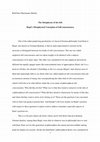
The Metaphysics of the Self. Hegel's Metaphysical Conception of Self-consciousness. One of the ra... more The Metaphysics of the Self. Hegel's Metaphysical Conception of Self-consciousness. One of the rather perplexing peculiarities of classical German philosophy from Kant to Hegel, also known as German Idealism, is that its main representatives insisted on the necessity to distinguish between two kinds of self-consciousness. The one was called empirical self-consciousness and was taken roughly to be identical with a subjects consciousness of its inner states. The other was considered to be non-empirical and went by different but equally opaque names like transcendental unity of apperception (Kant), the I as a deed-act (Fichte), the absolute I (Schelling) or the I as concept (Hegel). And whereas most of them had surprisingly little to say about what was called empirical self-consciousness they put an enormous amount of energy into conceptualizing the other kind of self-consciousness which I will refer to in what follows under the cover-name of philosophical selfconsciousness. Why did they do this? What was it what they found so attractive in the idea of a philosophical self-consciousness? What did they intend to characterize by means of this idea and where did they want to arrive at by relying on it? Those are the questions I am concerned with in what I am going to present here. And though I will focus mainly on Hegel's position with respect to these questions I cannot avoid to address sometimes especially aspects of Kant's position too. This is so because almost all stories which can be told about what post-Kantian German idealists, among them Hegel, were after in whatever area in philosophy have to start with Kant. Kant was for this generation of philosophers the natural and unavoidable starting point for mainly two reasons. On the one hand Kant's philosophical theory was considered by
Talks by Rolf-Peter Horstmann
Über Hegel in Berlin ist schon viel erzählt worden, und es ist zu erwarten, dass aus Anlass des i... more Über Hegel in Berlin ist schon viel erzählt worden, und es ist zu erwarten, dass aus Anlass des in einigen Monaten anstehenden 200jährigen Jubiläums seines Eintreffens in Berlin noch einiges mehr hinzukommen wird. Alle diese Erzählungenganz gleich ob Biographien, Lexikonartikel, Festreden oder Erlebnisberichtestimmen weitgehend darin überein, dass es
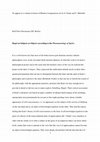
Hegel on Subjects as Objects (according to the Phenomenology of Spirit). It is a well-known fact ... more Hegel on Subjects as Objects (according to the Phenomenology of Spirit). It is a well-known fact that most of the better known post-Kantian (mostly) idealist philosophers were on the one hand wholehearted admirers of what they took to be Kant's philosophical project and at the same time the harshest critics of the way he realized this project in his three Critiques. They expressed this ambivalent attitude nicely in their often quoted proclamations that one has to distinguish between the letter and the spirit of Kant's philosophy and to preserve the latter (Reinhold, Fichte) or that one has to furnish the results of his philosophy with the appropriate premises, premises that Kant was lazy enough not to provide in detail or did not care to make explicit (Schelling, Hegel). Their critical assessment of Kant's enterprise was based on quite a number of alleged shortcomings of his teachings, among them most prominently his not just at first sight puzzling views about a double appearance of self-consciousness, i.e. its appearance as the subject of the activity of thinking on the one hand and as an object of knowledge/cognition on the other. They had the uneasy feeling that Kant's theory of self-consciousness as the basis of all knowledge/cognition in the guise of a theory of the transcendental unity of apperception (the 'I think') was somehow at odds with his claims as to what a subject in the guise of an empirical object can know about itself, claims that seem to amount to the view that this very I of apperception cannot become an object of knowledge/cognition. They were deeply dissatisfied with the idea that the I of
Books by Rolf-Peter Horstmann
Hegel on Concept Acquisition and Object Constitution in the different configurations of the Pheno... more Hegel on Concept Acquisition and Object Constitution in the different configurations of the Phenomenology of Spirit.



Uploads
Papers by Rolf-Peter Horstmann
Drafts by Rolf-Peter Horstmann
Talks by Rolf-Peter Horstmann
Books by Rolf-Peter Horstmann