Books by Kathleen Christian

Patronage and Italian Renaissance Sculpture
Patronage and Italian Renaissance Sculpture, 2010
This collection of essays argues that Italian Renaissance sculpture has been underrepresented in ... more This collection of essays argues that Italian Renaissance sculpture has been underrepresented in patronage studies, even though patrons profoundly shaped how sculptures were designed, made, displayed, and understood. It traces a shift from the Duecento–Trecento, when sculpture was chiefly a communal, civic, and ecclesiastical medium (façades, fountains, pulpits), to the Trecento–Cinquecento, when private patrons increasingly rivaled governments and churches, using costly and durable sculpture to claim prestige, occupy or “borrow” public space, and shape political identities. Essays emphasize how new patterns of domestic display, collecting, and reproductive technologies transformed the medium: elites sought unique modern works and prized antiquities as standards of value, while cheaper serial sculpture (terracotta, gesso, wax, ex-votos, plaquettes, medals) broadened access and fostered an art market beyond bespoke contracts. Methodologically, it reviews how scholarship moved from biographical and stylistic narratives toward social-network models of “shared agency,” clientage, gendered patronage, and economic signaling. Finally, it reframes sculptor–patron relations as ongoing negotiation—through contracts, drawings, models, workshop practice, and networks of travel and intermediaries—showing that patronage shaped not only objects and their meanings but also artists’ careers, reputations, and the later recontextualization of sculptures over time.
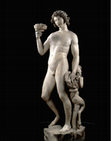
Raffaele Riario, Jacopo Galli, and Michelangelo’s Bacchus, 1471–1572, now available in print and ... more Raffaele Riario, Jacopo Galli, and Michelangelo’s Bacchus, 1471–1572, now available in print and online, investigates the intersection of Cardinal Raffaele Riario, the merchant-banker Jacopo Galli, and the young Michelangelo in late fifteenth-century Rome. The narrative is framed by the rise and fall of Riario and the Galli in an arc spanning from 1471—the election of Pope Sixtus IV, which marked the beginning of the Riario family’s ascendancy—to 1572, the year the Galli sold Michelangelo’s Bacchus to the Medici in Florence.
A thorough reassessment of their convergence sheds light on the careers of Riario and Galli as well as on Michelangelo’s Sleeping Cupid and Bacchus—two works long clouded by fundamental misperceptions. Chief among these are the belief that Michelangelo passed off his Sleeping Cupid to Riario as a “forgery”; the tradition, perpetuated by Ascanio Condivi’s 1553 Life of Michelangelo, that Galli rather than Riario commissioned the Bacchus; and the widespread presumption that Riario “rejected” the Bacchus. This study demonstrates instead that Michelangelo vigorously asserted his authorship of the Cupid. Michael Hirst’s discovery in 1981 of a payment record established Riario as the patron of the Bacchus; this book argues that the statue must be seen as a central product of Riario’s ambitious cultural program, and that no contemporary evidence supports the twentieth-century theory that the cardinal refused the work.
To reassess Riario’s identity as a patron, the study considers the politics and intellectual milieu that shaped his choices, beginning with the impression made on him by Marsilio Ficino during their encounter in the lead-up to the Pazzi Conspiracy in Florence (1478). In Rome, armed with the powerful office of Camerlengo, Riario launched a long and ambitious career as a patron. Of particular significance was his collaboration with Galli to rebuild San Lorenzo in Damaso and to reshape the neighborhood around the church in the Rione Parione. The study examines this immense project as well as the opportunities it created for Galli, notably his consolidation of a complex of properties—traced through maps, photographs, and archival documents. Chapters on Riario’s patronage explore his sponsorship of humanism, preaching, and the arts. They reconsider his role as a sponsor of theatre and festival, especially in relation to his support of the Spanish Reconquista, his promotion of astrology and Kabbalistic studies, and the construction of his villa in Trastevere—all aimed at bolstering his own status and that of the fragile Riario dynasty.
Set in this wider context, Michelangelo’s arrival in Rome and his work on the Sleeping Cupid and Bacchus take on new meaning. The reception of the Cupid in Rome and the commission of the Bacchus are reconsidered in detail, especially through the lens of Michelangelo’s first surviving letter, written in July 1496, in which he makes clear that he hoped to claim his own authorship of the Cupid when it was being deceptively sold as an antiquity by an unscrupulous dealer. The same letter describes Riario’s invitation to Michelangelo to view “certain figures” (no doubt, antiquities) and to do “something beautiful” in response. The resulting statue of the Bacchus (inspired in part by Antonio Federighi’s Sienese Bacchus) aimed to rival the antique and to assert the value of modern sculpture.
The book also redefines Galli’s role, showing him as far more than a banker. He emerges as poet, antiquities collector, and patron who acted as mediator, facilitator, and guarantor of Michelangelo’s early commissions, embedding the artist in a world of antiquarianism and collecting. His logistical and supportive role extended to the Young Archer in Manhattan, the Pietà in St. Peter’s, an altarpiece for Sant’Agostino, the Piccolomini monument in Siena, and the Bruges Madonna. He also occupied a prominent place in the intellectual and artistic circles of Renaissance Rome, at the center of a vibrant cultural milieu as a close friend of Jacopo Sadoleto, Pietro Bembo, Jacopo Mazzocchi, and others.
The final chapter considers the enduring presence of Michelangelo’s Young Archer and Bacchus in the Rione Parione, where they remained for more than sixty years, in the context of the lasting friendship between Michelangelo and Galli’s sons. A previously unknown commission from Michelangelo for a traveling altarpiece, requested by Galli’s sons for a journey to Bologna with Pope Julius II and Cardinal Riario, is also discussed. The book then traces the reception of the Bacchus in the houses of the Galli, where artists and other viewers could study it alongside the family’s collection of antiquities. Its display changed dramatically after the Sack of Rome, when the Galli properties were devastated and invading troops attempted to loot the Bacchus—almost certainly the occasion when Michelangelo’s statue was broken at the right wrist. It was drawn by Maarten van Heemskerck in a damaged state, missing its hand, in the aftermath of the Sack—a poignant moment in the intertwined histories of the sculpture and the Galli family. The decline of the Galli family continued, leading to the gradual dispersal of their collections and the sale of the Bacchus in 1572.
By moving beyond fixed interpretive frameworks and a long tradition of negative aesthetic judgments of the Bacchus, the study redefines the statue not as a failed experiment but as the outcome of a dense nexus of cultural, political, artistic, and economic interests. In so doing, it offers a reconsideration of Raffaele Riario’s patronage and Jacopo Galli’s identity, alongside a recontextualization of Michelangelo’s early career in Rome.
The book appears in the new Harvey Miller series All’antica edited by Cammy Brothers and Kathleen Christian.
Local Antiquities, Local Identities: Art Literature and Antiquarianism in Europe, c. 1400-1700, ISBN: 978-1-5261-1704-5, 2018
This collection investigates the wide array of local antiquarian practices that developed across ... more This collection investigates the wide array of local antiquarian practices that developed across Europe in the early modern era, c. 1400-1700. Breaking new ground, it explores local concepts of antiquity in a period that has been defined as a uniform 'Renaissance'. Contributors take a novel approach to the revival of the antique in different parts of Italy, as well as examining other, less widely studied antiquarian traditions in France, the Netherlands, Spain, Portugal, Britain and Poland. They consider how real or fictive ruins, inscriptions and literary works were used to demonstrate a particular idea of local origins, to rewrite history or to vaunt civic pride. In doing so, they tackle such varied subjects as municipal antiquities collections in Southern Italy and France, the antiquarian response to the pagan, Christian and Islamic past on the Iberian Peninsula, and Netherlandish interest in megalithic ruins thought to be traces of a prehistoric race of Giants.
Traditionally, the Renaissance has been understood as a strictly Western phenomenon, a period of ... more Traditionally, the Renaissance has been understood as a strictly Western phenomenon, a period of cultural and technological ‘advancement’ inspired by humanism and antique revival. European art and the wider world 1350–1550 takes a different approach. Informed by the latest scholarship in the field of art history, it explores the significance of the movement of knowledge, ideas and objects for the visual culture of Europe, against the backdrop of a global competition for power and resources.
The book investigates famous works of art from a new perspective, taking account of the complex relationships that bound Europe together with Asia, America and Africa. It also considers lesser-known objects such as ceramics, textiles and featherwork which were widely imported into Europe. Considering a range of geographical contexts from Spain to India, it explores European visual culture in the light of trade, colonisation, conversion and cultural exchange. Individual chapters examine the altarpiece in a global context; cultural encounters on the Iberian Peninsula and in the Americas; European collections of non-European objects; and Venice’s engagement with the Islamic Ottoman Empire and Mamluk Sultanate.
European art and the wider world is the first textbook to consider the Renaissance in the context of global art history. It will appeal to undergraduate art history students as well as a general readership eager to look at canonical works from a new perspective.
Articles and book chapters by Kathleen Christian

La forma delle Muse: un dialogo di parole e immagini. Atti del convegno internazionale, Urbino 9-11 dicembre 2024, 2025
This article examines the origins, methodological foundations, and future development of the Cens... more This article examines the origins, methodological foundations, and future development of the Census of Antique Works of Art and Architecture Known in the Renaissance (est. 1946), a long-term research project dedicated to linking classical monuments with their representations in post-classical images and texts. Tracing and intellectual context of its formation, the essay situates the Census between archaeological empiricism and art-historical inquiry, while also addressing its dialogue with the contrasting historiographical models of Erwin Panofsky and Aby Warburg.
The article analyzes the project’s transformation from a card-based archive to a digital, open-access database and reflects on recent revisions to its data model, which move beyond rigid distinctions between “authentic” antiquities and their post-classical documentation. By foregrounding the interpretative role of digital images and the fluidity of early modern concepts of antiquity, the study considers how the Census can be better aligned with current approaches in reception studies.
Finally, the article considers future directions for the project, including semantic data modeling, interoperability within digital humanities infrastructures, and the potential of AI-driven visual and textual analysis. It argues that the Census can strive to evolve from a repository of empirical knowledge into a research environment capable of capturing the complex, non-linear processes through which antiquity has been constructed, transmitted, and reimagined.
Archeologia e Calcolatori, 2025
The Census of Antique Works of Art and Architecture Known in the Renaissance, established in 194... more The Census of Antique Works of Art and Architecture Known in the Renaissance, established in 1946, is a research project that traces the knowledge and reception of antiquities known during the Renaissance by linking them with Early Modern visual and textual records. It has over its long history evolved from an analog system, to one of the earliest digital art history projects, to an online database (https://database.census.de). Recent innovations (2021–2023) have transformed the database into semantic data using the CIDOC-CRM ontology, aligning it with FAIR principles and encouraging broader engagement with the Census’s rigorously-researched dataset. The modeling process involved creating eight Semantic Census models, supported by extensive documentation. The semantic transformation of Census data used the X3ML language and 3M tool for mapping and verification, ensuring consistency and compatibility with other datasets, such as those in the CORDH network. Queries can now be performed using SPARQL, with documented query examples to guide researchers unfamiliar with semantic data. The Semantic Census models have the ability to facilitate new research purposes for Census data, not only in the fields of art history and archaeology, but also beyond the project’s original scope.
Chefs d'oeuvre de la collection Torlonia, ed. by Carlo Gasparri, Salvatore Settis, and Martin Szewczyk, 2024
The Torlonia collection, and the Louvre, inherited antique sculptures assembled by Roman aristocr... more The Torlonia collection, and the Louvre, inherited antique sculptures assembled by Roman aristocracy between the 15th and 18th centuries, and many works in both collections were originally part of early modern collections displayed in Roman palaces and gardens. During the Napoleonic era Napoleon’s armies and his agent Dominique-Vivant Denon seized many antiques from Rome’s pontifical and private collections; though most were returned, some remained in France. Added to these were the extraordinary wealth of antiquities Napoleon purchased in 1807 from his brother-in-law Camillo Borghese, as well as the smaller selection Louis XVIII bought in 1815 from the Albani. It was also around this time that the Torlonia, a family of French origins who were bankers to the Bonaparte, rose to prominence and began collecting from similar sources in Rome, acquiring significant antiques from collections such as those of Bartolomeo Cavaceppi, the Giustiniani family, and the Villa Albani. This essay explores how the Torlonia collection and the Louvre have intertwined histories, whose comparison sheds light in new developments in museum practices influenced by Rome’s centuries-long history of collecting.
La scuola del mondo, Storie globali dalla collezione Farnese, ed. Simone Verdi (Milan), 2022
This essay considers the political, aesthetic and geographical orientations that marked the forma... more This essay considers the political, aesthetic and geographical orientations that marked the formation of the Farnese collections during the sixteenth century.
In the space of a few generations, the Farnese accumulated extraordinary power, exploiting their access to the papacy and to the courts of the Hapsburgs and the royal family of Portugal. They built up exceptional collections of art in Rome, the duchy of Parma and Piacenza, Caprarola and the Netherlands, which combine antiquities, paintings from various European schools, objects in rock crystal, 'rarites' and objects from Asia, Africa and the Americas.
As this essay discusses, one of the themes that stands out in the richness and variety of the Farnese collections is that of empire: not only the idea of a reborn Roman empire, but also links with the greatest empire-builders of the 16th century, the courts of the Habsburgs and the Portuguese crown.
La forme idéale à la Renaissance / Forma ideale durante il Rinascimento, 2023
An assessment of the Roman notebook of the French jurist Claude de Bellièvre as an insight to vie... more An assessment of the Roman notebook of the French jurist Claude de Bellièvre as an insight to viewing practices and the combination of viewing and note-taking in Renaissance Rome.
Restoration as Fabrication of Origins A Material and Political History of Italian Renaissance Art, edited by Henri de Riedmatten, Fabio Gaffo and Mathilde Jaccard. De Gruyter (Open Access)., 2023
This article traces the development of restauratio, the practice of piecing together of fragile, ... more This article traces the development of restauratio, the practice of piecing together of fragile, broken objects, as an alternative antiquarian practice to translatio, the movement of large and heavy objects from one place to another. It considers how restauratio developed in a close relationship with the recovery of antique literary works. At a time when humanists sought to rescue and repair ancient texts that they described as broken and mutilated bodies, buried in libraries, the restoration of antique sculptures (through excavation, rediscovery and the reattachment of missing pieces) took on similar cultural meaning. This essay explores the relationship between concepts of restoration and translation in the context of the word-image dynamic in Renaissance Rome.
In: Public Statues Across Time and Cultures, ed. C. P. Dickenson. New York, Routledge, 2021
In: I marmi Torlonia. Collezionare capolavori, 2020
Ka thl ee n W. Ch ris tian Le col lez ion i di scu ltu ra ant ica nel la Ro ma rina scim ent ale
This collection investigates the wide array of local antiquarian practices that developed across ... more This collection investigates the wide array of local antiquarian practices that developed across Europe in the early modern era. Breaking new ground, it explores local concepts of antiquity in a period that has been defined as a uniform 'Renaissance'. Contributors take a novel approach to the revival of the antique in different parts of Italy, as well as examining other, less widely studied antiquarian traditions in France, the Netherlands, Spain, Portugal, Britain and Poland. They consider how real or fictive ruins, inscriptions and literary works were used to demonstrate a particular idea of local origins, to rewrite history or to vaunt civic pride. In doing so, they tackle such varied subjects as municipal antiquities collections in Southern Italy and France, the antiquarian response to the pagan, Christian and Islamic past on the Iberian Peninsula, and Netherlandish interest in megalithic ruins thought to be traces of a prehistoric race of Giants.
In: Local antiquities, local identities: Art, literature and antiquarianism in Europe, c. 1400–17... more In: Local antiquities, local identities: Art, literature and antiquarianism in Europe, c. 1400–1700, ed. by K. Christian and B. de Divitiis, 2018, pp. 57-78.
In: European Art and the Wider World 1350–1550, edited by Kathleen Christian and Leah R. Clark. Manchester, Manchester University Press, 2017
In: Newall, D. (ed.) Art and its global histories: a reader, Manchester University Press, 2017, p... more In: Newall, D. (ed.) Art and its global histories: a reader, Manchester University Press, 2017, pp. 50-112.
This section of the reader, published in conjunction with the Open University module Art and its global histories, includes primary texts and four critical essays related to the global history of art in the period 1350-1550.
In: The Companions to the History of Architecture, Volume I, Renaissance and Baroque Architecture... more In: The Companions to the History of Architecture, Volume I, Renaissance and Baroque Architecture. Edited by Alina Payne. 2017.
In: Marcantonio Raimondi, Raphael and the Image Multiplied (exhibition catalogue), ed. by. E. H. ... more In: Marcantonio Raimondi, Raphael and the Image Multiplied (exhibition catalogue), ed. by. E. H. Wouk. Manchester, Manchester University Press, 2016, pp. 66-83.



Uploads
Books by Kathleen Christian
A thorough reassessment of their convergence sheds light on the careers of Riario and Galli as well as on Michelangelo’s Sleeping Cupid and Bacchus—two works long clouded by fundamental misperceptions. Chief among these are the belief that Michelangelo passed off his Sleeping Cupid to Riario as a “forgery”; the tradition, perpetuated by Ascanio Condivi’s 1553 Life of Michelangelo, that Galli rather than Riario commissioned the Bacchus; and the widespread presumption that Riario “rejected” the Bacchus. This study demonstrates instead that Michelangelo vigorously asserted his authorship of the Cupid. Michael Hirst’s discovery in 1981 of a payment record established Riario as the patron of the Bacchus; this book argues that the statue must be seen as a central product of Riario’s ambitious cultural program, and that no contemporary evidence supports the twentieth-century theory that the cardinal refused the work.
To reassess Riario’s identity as a patron, the study considers the politics and intellectual milieu that shaped his choices, beginning with the impression made on him by Marsilio Ficino during their encounter in the lead-up to the Pazzi Conspiracy in Florence (1478). In Rome, armed with the powerful office of Camerlengo, Riario launched a long and ambitious career as a patron. Of particular significance was his collaboration with Galli to rebuild San Lorenzo in Damaso and to reshape the neighborhood around the church in the Rione Parione. The study examines this immense project as well as the opportunities it created for Galli, notably his consolidation of a complex of properties—traced through maps, photographs, and archival documents. Chapters on Riario’s patronage explore his sponsorship of humanism, preaching, and the arts. They reconsider his role as a sponsor of theatre and festival, especially in relation to his support of the Spanish Reconquista, his promotion of astrology and Kabbalistic studies, and the construction of his villa in Trastevere—all aimed at bolstering his own status and that of the fragile Riario dynasty.
Set in this wider context, Michelangelo’s arrival in Rome and his work on the Sleeping Cupid and Bacchus take on new meaning. The reception of the Cupid in Rome and the commission of the Bacchus are reconsidered in detail, especially through the lens of Michelangelo’s first surviving letter, written in July 1496, in which he makes clear that he hoped to claim his own authorship of the Cupid when it was being deceptively sold as an antiquity by an unscrupulous dealer. The same letter describes Riario’s invitation to Michelangelo to view “certain figures” (no doubt, antiquities) and to do “something beautiful” in response. The resulting statue of the Bacchus (inspired in part by Antonio Federighi’s Sienese Bacchus) aimed to rival the antique and to assert the value of modern sculpture.
The book also redefines Galli’s role, showing him as far more than a banker. He emerges as poet, antiquities collector, and patron who acted as mediator, facilitator, and guarantor of Michelangelo’s early commissions, embedding the artist in a world of antiquarianism and collecting. His logistical and supportive role extended to the Young Archer in Manhattan, the Pietà in St. Peter’s, an altarpiece for Sant’Agostino, the Piccolomini monument in Siena, and the Bruges Madonna. He also occupied a prominent place in the intellectual and artistic circles of Renaissance Rome, at the center of a vibrant cultural milieu as a close friend of Jacopo Sadoleto, Pietro Bembo, Jacopo Mazzocchi, and others.
The final chapter considers the enduring presence of Michelangelo’s Young Archer and Bacchus in the Rione Parione, where they remained for more than sixty years, in the context of the lasting friendship between Michelangelo and Galli’s sons. A previously unknown commission from Michelangelo for a traveling altarpiece, requested by Galli’s sons for a journey to Bologna with Pope Julius II and Cardinal Riario, is also discussed. The book then traces the reception of the Bacchus in the houses of the Galli, where artists and other viewers could study it alongside the family’s collection of antiquities. Its display changed dramatically after the Sack of Rome, when the Galli properties were devastated and invading troops attempted to loot the Bacchus—almost certainly the occasion when Michelangelo’s statue was broken at the right wrist. It was drawn by Maarten van Heemskerck in a damaged state, missing its hand, in the aftermath of the Sack—a poignant moment in the intertwined histories of the sculpture and the Galli family. The decline of the Galli family continued, leading to the gradual dispersal of their collections and the sale of the Bacchus in 1572.
By moving beyond fixed interpretive frameworks and a long tradition of negative aesthetic judgments of the Bacchus, the study redefines the statue not as a failed experiment but as the outcome of a dense nexus of cultural, political, artistic, and economic interests. In so doing, it offers a reconsideration of Raffaele Riario’s patronage and Jacopo Galli’s identity, alongside a recontextualization of Michelangelo’s early career in Rome.
The book appears in the new Harvey Miller series All’antica edited by Cammy Brothers and Kathleen Christian.
The book investigates famous works of art from a new perspective, taking account of the complex relationships that bound Europe together with Asia, America and Africa. It also considers lesser-known objects such as ceramics, textiles and featherwork which were widely imported into Europe. Considering a range of geographical contexts from Spain to India, it explores European visual culture in the light of trade, colonisation, conversion and cultural exchange. Individual chapters examine the altarpiece in a global context; cultural encounters on the Iberian Peninsula and in the Americas; European collections of non-European objects; and Venice’s engagement with the Islamic Ottoman Empire and Mamluk Sultanate.
European art and the wider world is the first textbook to consider the Renaissance in the context of global art history. It will appeal to undergraduate art history students as well as a general readership eager to look at canonical works from a new perspective.
Articles and book chapters by Kathleen Christian
The article analyzes the project’s transformation from a card-based archive to a digital, open-access database and reflects on recent revisions to its data model, which move beyond rigid distinctions between “authentic” antiquities and their post-classical documentation. By foregrounding the interpretative role of digital images and the fluidity of early modern concepts of antiquity, the study considers how the Census can be better aligned with current approaches in reception studies.
Finally, the article considers future directions for the project, including semantic data modeling, interoperability within digital humanities infrastructures, and the potential of AI-driven visual and textual analysis. It argues that the Census can strive to evolve from a repository of empirical knowledge into a research environment capable of capturing the complex, non-linear processes through which antiquity has been constructed, transmitted, and reimagined.
In the space of a few generations, the Farnese accumulated extraordinary power, exploiting their access to the papacy and to the courts of the Hapsburgs and the royal family of Portugal. They built up exceptional collections of art in Rome, the duchy of Parma and Piacenza, Caprarola and the Netherlands, which combine antiquities, paintings from various European schools, objects in rock crystal, 'rarites' and objects from Asia, Africa and the Americas.
As this essay discusses, one of the themes that stands out in the richness and variety of the Farnese collections is that of empire: not only the idea of a reborn Roman empire, but also links with the greatest empire-builders of the 16th century, the courts of the Habsburgs and the Portuguese crown.
This section of the reader, published in conjunction with the Open University module Art and its global histories, includes primary texts and four critical essays related to the global history of art in the period 1350-1550.